China Shaking table gravity separation machine for beneficiation Manufacturer, Products

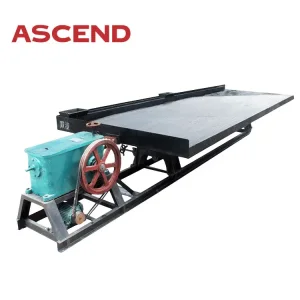
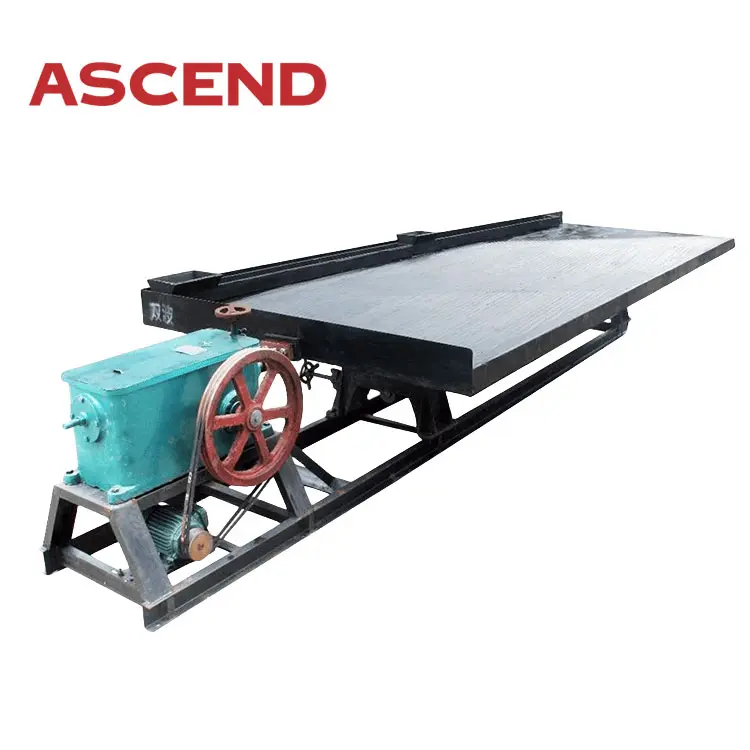
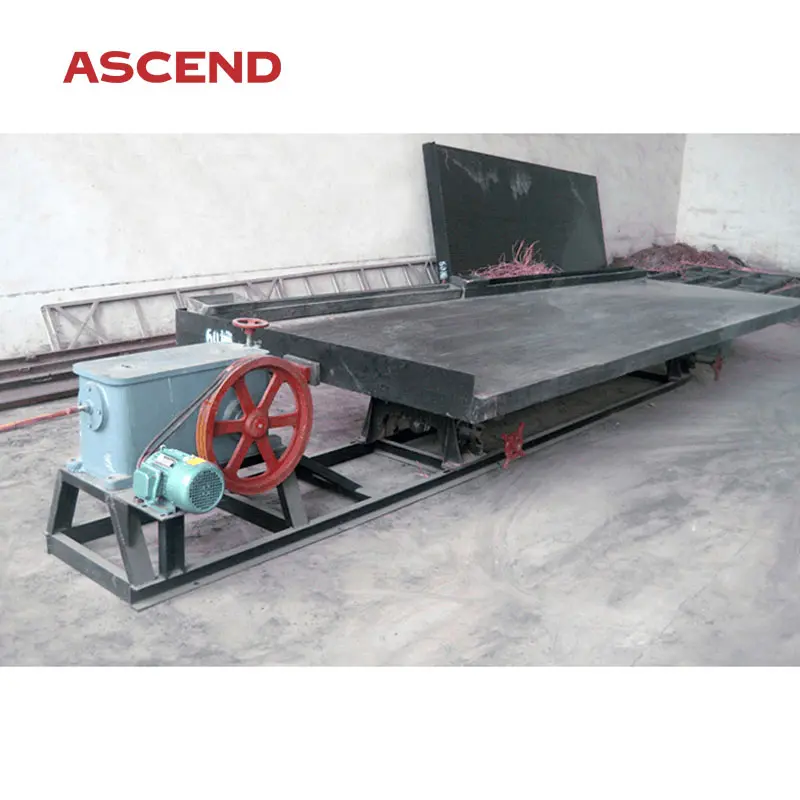
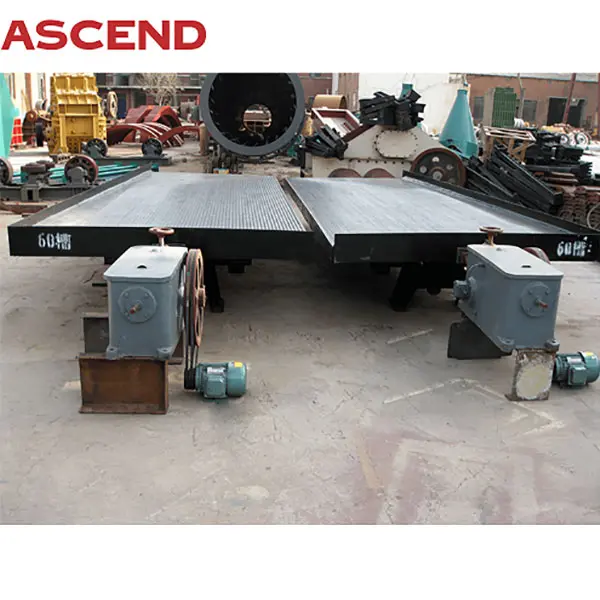
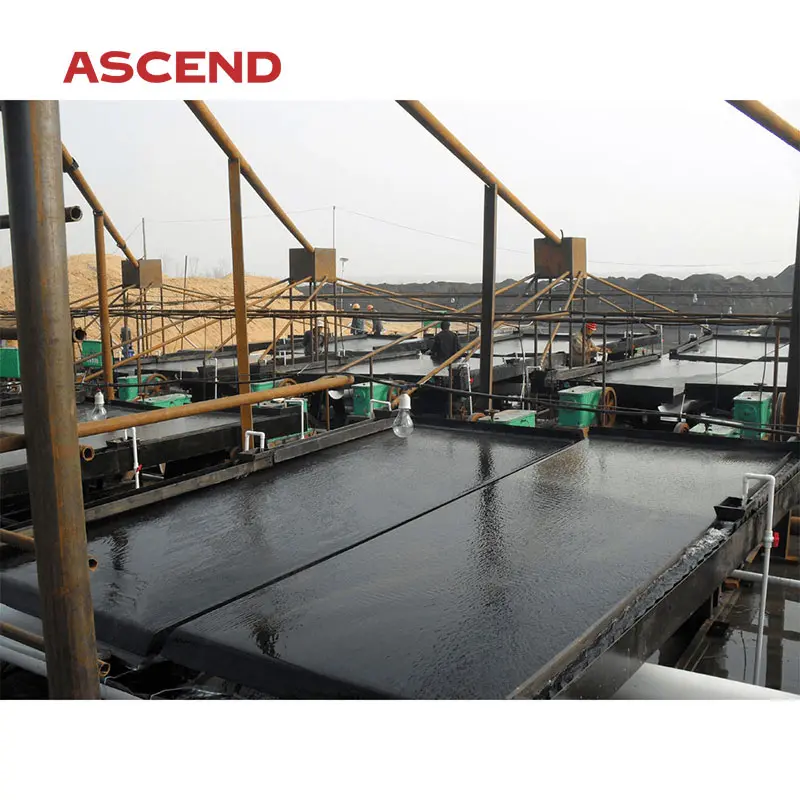
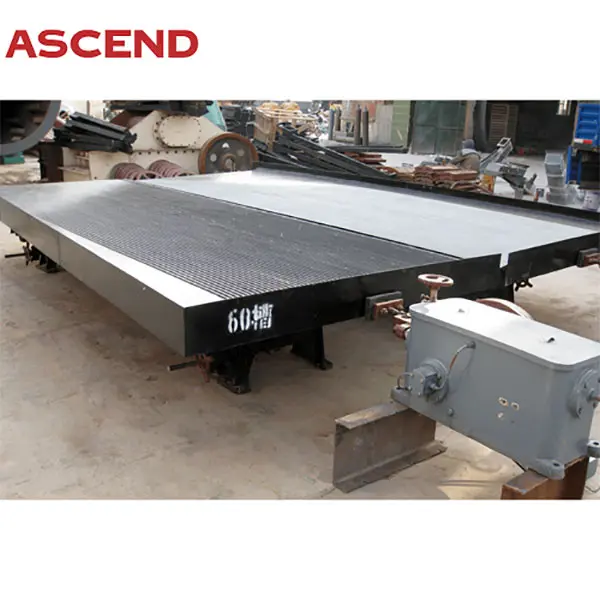
Shaking table is kind of gravity separation machine used for the benificiation of precious metals, rare metals, non-metallic minerals. It is mainly composed of table head, electric motor, gradient adjusting device, table surface, ore chute, water chute and lubricating system. It is usually used for rough concentrating, scavenging process and selecting different particle of rough sand, fine sand and ore mud. Besides, by attaching to wet pan mill, gold kacha, it could separate gold as a production line. ASCEND shaking table has advantages of high efficiency, high recovery, low production cost.

Product Description

Working Principle

Beneficiation of shaking table is a process that the mineral particles are loosened, layered, and banded on the inclined bed surface by the combined action of mechanical asymmetric reciprocating motion and thin-layer inclined water flow. The minerals can be sorted according to density.

First, add materials into the ore chute. The table surface is inclined, and many parallel riveting bars or grooves is nailed on the table surface along the longitudinal direction. There is a transmission mechanism installed at the end of the shaking table, which drives the bed surface to shake asymmetrically in the longitudinal direction. The bed surface is tilted toward the tailings side at a horizontal angle of 1.5 to 5 degrees. Then the slurry and flushing water are fed from the side with a higher slope of the bed surface. By impact of the fluid and the differential reciprocating force of the transmission device on the shaking table, the mineral particles are layered according to density and particle size and move along the bed surface in different directions, showing regular fan-shaped banding. At last they are discharged from different areas with separating into concentrate, middlings, and tailings by separate collection.
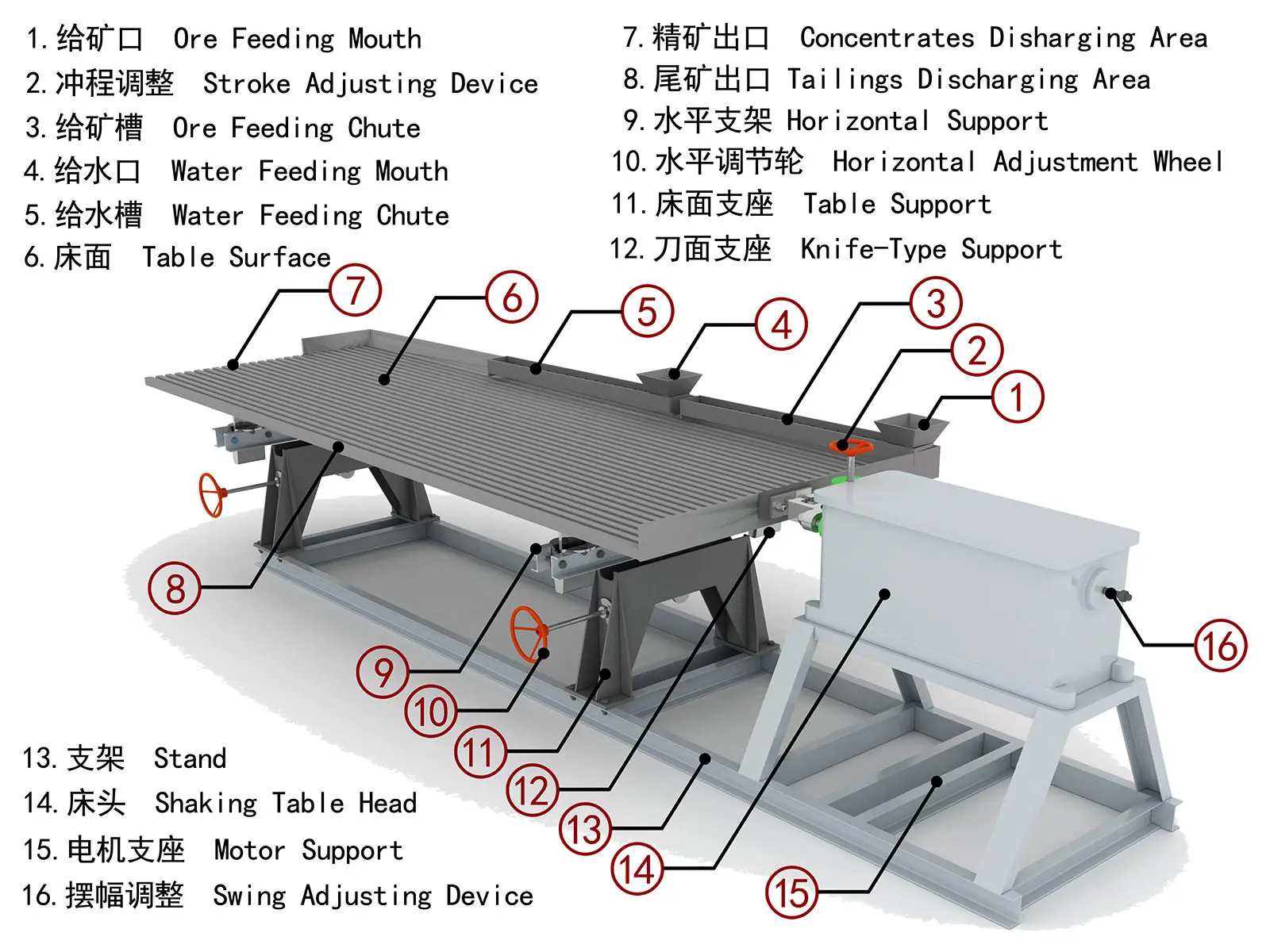
shaking table detail1

Main Technical Parameters

Model Stroke (mm) Time/min Surface Size of Table (mm) Motor (kw) Overall Dimensions (mm) Surface Weight of Table (kg)
6-S 10-30 240-360 152x1825x4500 1.1 5454x1825x1242 1012
Material Type Feed Size (mm) Mine Density (%) Flushing Water (t/h) Capacity (t/h)
Coarse sand 2.0-2.5 20-30 0.7-1.0 1.0-1.8
Fine sand 0.5-0.074 18-25 0.7-1.0 0.5-1.0
Ore mud -0.074 15-20 0.4-0.7 0.3-0.5

Frequently Asked Questions

Q1. What is the basic working principle of a shaking table?
The mineral particles are loosened, layered, and separated on an inclined bed surface. This occurs through the combined effects of an asymmetric reciprocating mechanical movement and a thin layer of flowing inclined water, allowing sorting by density.
Q2. How does the shaking table separate feed materials into different zones?
As slurry and water flow down the inclined surface, the differential reciprocating force drives particles in different directions. This results in regular fan-shaped banding based on density and size, enabling separate collection of concentrate, middlings, and tailings.
Q3. What are the key design specifications of the 6-S model shaking table?
The 6-S model features a stroke of 10-30 mm, operates at 240-360 strokes per minute, uses a 1.1 kw motor, and has table surface dimensions of 152x1825x4500 mm with a weight of 1012 kg.
Q4. What is the processing capacity of the shaking table for coarse sand?
For coarse sand with a feed size of 2.0-2.5 mm and a mine density of 20-30%, the capacity ranges from 1.0 to 1.8 tons per hour, requiring a flushing water rate of 0.7-1.0 tons per hour.
Q5. How does feed size affect the capacity when processing fine sand and ore mud?
Fine sand (0.5-0.074 mm feed size) has a capacity of 0.5-1.0 tons per hour. Ore mud (under 0.074 mm feed size) has a lower capacity of 0.3-0.5 tons per hour due to its smaller particle profile.

Related Products